Vine Maple, high elevation huckleberry bushes and Larch (Tamarack) are the main sources of fall color and begin turning in late September. Larch is golden and is visible after much of the other color is gone. It is only found in the Chinook Pass and White Pass areas among the other evergreen trees. It is worth searching out, because the Larch is very localized and unique in Washington State. Spectacular displays are seen until the snow begins to fall in November.
On the White Pass Scenic Byway, US Hwy 12, fall colors are climaxed by the Larch on the east side of White Pass in November. Beginning in September check here for Fall Color Information and newly submitted photos of nature's beauty.
Whether you are traveling Chinook Pass, State Route 410, or White Pass, U.S. Highway 12, you will be astounded by the brilliance of fall colors. Cottonwoods, willows, elderberry, aspen, tamarack (western larch), and every deciduous tree and shrub is in transition and the colors will amaze you.
For those who travel off road or have a high clearance vehicle, you can drive from White Pass Highway to Chinook Pass via Bethel Ridge road 1500 and take it all in. Once on top Bethel Ridge you will be absolutely astounded by the transition in colors across the landscape. While you slowly descend from the ridge towards the Rattlesnake Drainage, take a short side trip to Cash Prairie, FS road 1500-199, for a view of the Rattlesnake towards Bismark Peak and the surrounding areas. Drive a short distance further to the 190 spur to Timberwolf Mountain and no matter what direction you look it will seem as if you are standing above a colorful carpet of crimson, amber, and gold. Don't forget the camera. Another side trip is traveling the backside of Rimrock Lake on Tieton Road, FS road 1200. Colors along the lake and hills dotted with tamarack are well worth the trip. Near the Tieton airstrip a grove of Aspen will open your eyes.
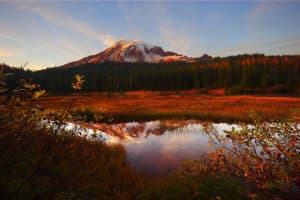
Set against a backdrop of evergreen conifers, vine maples are ablaze with color, larches shine golden and huckleberries are bursting with shades of crimson. The air is crisp and fall is on full display. Come hike at Mt. Rainier during this special time of year - choose from the following list.
Non-commerical berry picking is allowed within the National Park. Two quarts per person per day of huckleberries, blackberries, thimbleberries and salmonberries may be gathered by hand. This small quantity has been determined to not adversely affect park wildlife, the reproductive potential of the plant species, or otherwise adversely affect park resources. Berry picking tip: huckleberries are best at Indian Henry's Hunting Grounds and along the Noble Knob trail.
The area just outside the southern boundaries of the park is also well known for huckleberry picking, which grow in open areas at elevations over 4,000 feet. East Lewis County near Packwood and Randle are the most popular areas. Three gallons per person are allowed (non commercial) without a permit. More information can be found at Gifford Pinchot National Forest's Huckleberry Locations.
Dozens of good edible mushroom species begin to appear in late summer. Most species need the first fall rains to come before they appear. Some species wait until the first frosts. As is well-known mushrooms can be poisonous, so mushroom hunters need to have positively identified species before picking. The woods and valleys around Lewis County on the southern side of Mt. Rainier National Park boast varieties such as chanterelles, matsutake (pine mushrooms) and some species of boletus. Others such as shaggy manes, brain mushrooms (false morels), hen-of-the-woods and pig's ear are common as well. It is important for everyone to be aware of property ownership. The Gifford Pinchot and Mt. Baker-Snoqualmie National Forests, as well as the Department of Natural Resources, may require a permit for limited collections. Permit info here.
Morel Mushrooms are now being found at lower elevations near Packwood, Greenwater and Ashford. A permit is required to collect in National Forests.
Non-commercial mushroom picking is allowed within the National Park, up to two quarts per person per day. Mushroom collecting tip: the hike between Narada Falls and Longmire is the best area for locating edible fungi.
The Pumpkin Express: Ride the train to the Mineral Lake Pumpkin Patch. The "Great Pumpkin" will greet your young ones and host a hunt through the hay stacks for their very own pumpkin to take home. Don't forget your costume and camera! Enjoy the cool temperatures and beautiful colors found only this time of year in the foothills of Mt. Rainier.
Take time to enjoy the fall weather as you travel through the beautiful foothills of Mount Rainier on a historic steam train ride. You will depart from Elbe for a 45 minute ride out to pristine Mineral Lake for a short visit before returning to the depot in Elbe. See Mt. Rainier's autumn brilliance on display with colors of crimson, golds and oranges.